Corruption and greed take down a prominent Chicago area hospital with deadly results.
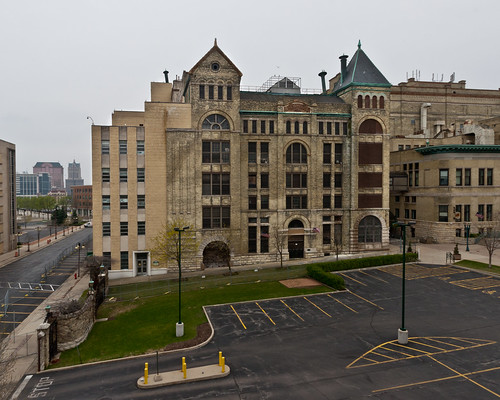
The nation is galvanized by a young man bleeding to death at the doorstep of Ravenswood Hospital in Chicago.
Gary, Indiana's first high school offered great education opportunities for students... if you were the right skin color.
A Gary, Indiana school that gained international recognition amongst progressives now lies in ruin.

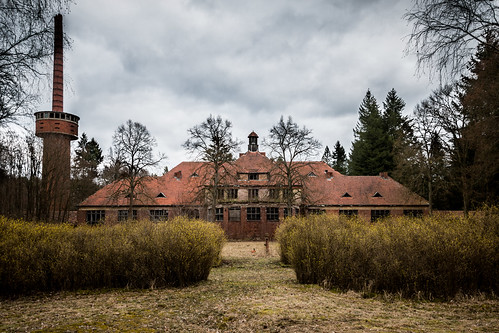
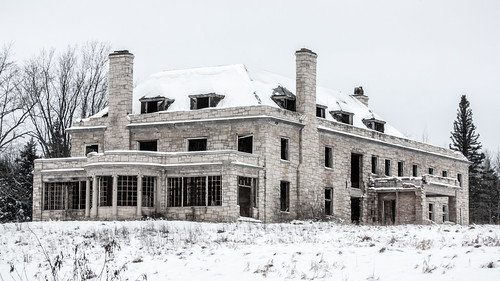
Photo: All that remains of the Alexian Brothers Novitiate.
The well-to-do widow of lawyer F. M. Peters, Mrs. Jennie Peters, dearly loved her daughter. In the latter portion of the 1930′s architects John King and Gordon Feldhausen were tasked with creating a unique building just for her. Unlike the farmhouses, barns, and silos typical for the Gresham, WI community this structure would be designed around a single individual. The expansive home surrounded by trees along the banks of the Red River would provide much needed respite to Jennie’s disabled daughter Jane.
Unfortunately Jane would never set foot in the house. She passed away just six weeks after construction began.
Undeterred by the unfortunate events, Mrs. Peters made the mansion in the quite rural community her home. When completed the stone Georgian colonial building featured 20 rooms. On the first floor the were the drawing room, library, guest room, dining room, kitchen, pantry and laundry. The second floor had three bedrooms, three bathrooms, and four rooms for the maids. A nearby four car garage also had quarters above it. The total cost of the property amounted to $250,000 (or approximately $3.9 million adjusting for inflation).

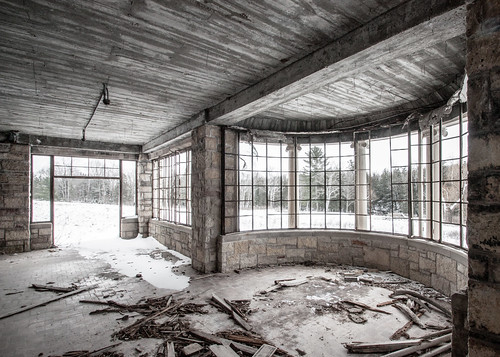
Photo: One of the few remaining beautiful architectural flairs in an otherwise empty mansion.
Although Jennie was able to assimilate into the community there were rumors that one day she would give the property away. The rumor bore truth in 1950 when Jennie gifted the 232-acre estate to the Alexian Brothers Novitiate. Shortly thereafter novices preparing for service to the Catholic church moved to the novitiate to begin their training. A $1.5 million (about $12 million today) facility named Peters Hall was built adjacent to the mansion to serve the growing number of faculty, staff, and novices.
The novitiate struggled to keep pace with the edicts of the Second Vatican Council, which required its religious orders provide a college level education to novices. This meant that novices had to travel 55 miles to St. Norbert’s College in De Pere, WI. The commute proved to be time-consuming, expensive, and as anyone who has driven through Wisconsin in the middle of winter knows, dangerous at times. The decision was made in 1968 to relocate the novitiate to Chicago.
In the following years the property received no substantial bids when placed on the market. In 1974 negotiations were in motion with the Green Bay Alcohol and Drug Abuse Council to convert the novitiate into a rehabilitation center. Those plans came to a screeching halt around midnight on New Year’s Eve. The caretaker Joe Plonka, his wife, two children, and two friends were awoken by armed members of the Menominee Warrior Society seizing control of the novitiate buildings. The Menominee Warrior Society began their occupation of the property claiming that the lands rightfully belonged to their tribe.
With experienced Vietnam veterans in their midst the Menominee Warrior Society quickly secured their foothold. In response local, state, and federal agents quickly descended upon the area. Electricity and telephone service for the novitiate were cut. A perimeter with guarded checkpoints around the area were erected. Tensions ran high as shots were frequently exchanged between the occupiers and government officials. The Menominee Warrior Society’s goals were clear in their negotiations with their motto “deed or death.”

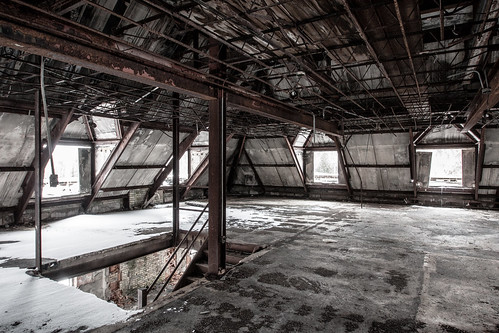
Photo: The top of the mansion where Menominee Warrior Society members kept watch.
Seeking to avoid bloodshed the Alexian Brothers Novitiate sold the property to the Menominee Tribe for $1. On February 3, 1975 the members of the Menominee Warrior Society willingly turned themselves over to the National Guard. The 34 day standoff ended with no major injuries between the Menominee Warrior Society and officials. The ordeal could have ended a lot sooner as Menominee Warrior Society general Mike Sturdevant later admitted that they ran out of ammunition on January 4.
As per the negotiated agreement the Menominee Tribe would have to make a “good faith” effort to reimburse the novitiate $750,000 for the property. They were unable to afford upkeep on the facility and ceded control back to the Alexian Brothers Novitiate after just five months. The novitiate fielded several proposals from potential new occupants, but nothing substantial ever materialized.
On the morning of October 11, 1975 the neighbors adjacent to the novitiate noticed smoke billowing above the trees. Due to a dense fog a fire raged for hours within the mansion. Responders to the scene described the inside as a total loss.
After the suspected arson the property changed hands several times. The remaining structures fell into disrepair after decades of neglect. Frequent break-ins and vandalism hastened its decline. In 2003 everything but the mansion was torn down. Some of the land has since been parceled out, though the main property with the gutted mansion remains.
Video (source): J. Patrick Rick’s documentary “The Abbey & Me.”
Resources:
Alexian Brothers – Comprehensive history of the Alexian Brothers Novitiate estate in Gresham, WI.
Google News – April 13, 1941 Milwaukee Journal article describing the origins of the mansion.
Google News – January 2, 1975 Milwaukee Journal article on the Menominee Warrior Society occupation.
Google News - February 4, 1975 News and Courier article on the history of the Alexian Brothers.
Google News – March 17, 1975 Milwaukee Journal article on the lack of ammunition.
Google News – October 13, 1975 Lewiston Daily Sun article on the fire in the mansion.
Wikipedia – Entry for Alexian Brothers Novitiate
YouTube – J. Patrick Rick’s documentary “The Abbey & Me.”
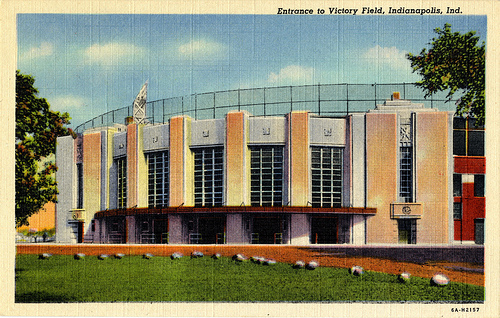
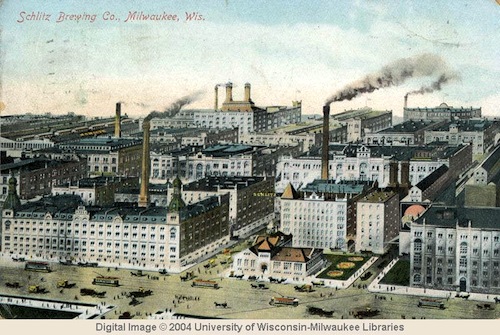
Photo (source): A postcard of the stadium in its prime.
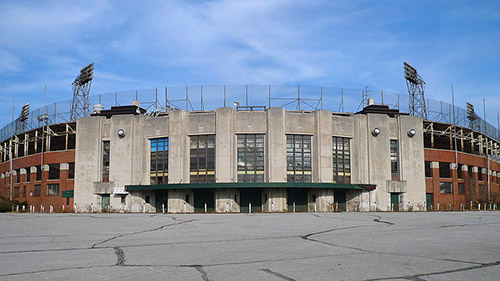
Photo (source): Bush Stadium after years of decay.
Social conditions in early 1900′s America saw a massive shift in the way the working class lived. Electricity, automobiles, health and safety laws, worker’s rights legislation, improved public education, and government funded infrastructure afforded the working class the opportunity to thrive. Progress meant that the American public gained more time for leisure activity. Many Americans sought to occupy their free time devoted to baseball.
Baseball was a package ripe for entrepreneurs to capitalize upon. The drama of the game had its winners and losers, heroes and villains, its loyal followers, and content perfect for radio and print media transmission. The stadium became a cathedral where the faithful throngs could worship the game whilst owners reaped the economic rewards. A team worthy of reverence is, therefore, deserving of a stadium demonstrative of its glory.

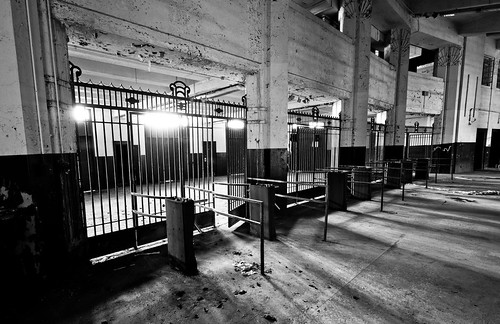
Photo: The main gate turnstiles at the abandoned stadium.
During the golden age of baseball stadiums were erected as a testament to the game. In 1931 the Art Deco stylized stadium Perry Field opened its gates to fans of the minor league Indianapolis Indians. The name held until World War II when the field was rechristened to the patriotic Victory Field. Once the field was sold to the city of Indianapolis in 1967 it was renamed to its current namesake Bush Stadium.
In its prime Bush Stadium was the template for what other baseball stadiums should aspire to. The red brick lined outfield was covered in ivy. During gameplay the scoreboard had to be manually changed to reflect current statistics. Unobstructed views meant that there was not a single bad seat in the house. The venue played host to American Association, Pacific Coast League, International League, and Negro League games.

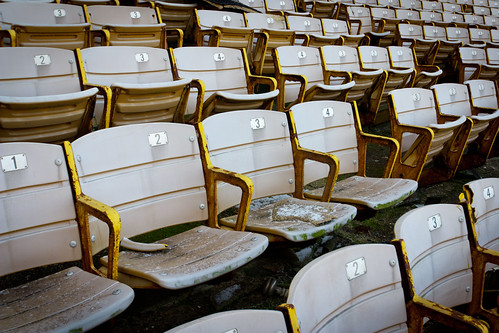
Photo: Cold empty seats without the warm presence of adoring fans.
Baseball games continued at the park until 1996 when the Indianapolis Indians moved to the more modern Victory Field. For two years the stadium had an identity crisis as the infield was ripped out to make a dirt racing track known as the 16th Street Speedway. For nearly a decade the stadium fell into disrepair. For a time the once beloved venue became a graveyard for vehicles traded in for the government “cash for clunkers” incentive program.
Once the cars were cleared away Indianapolis began to stoke development interest in the neglected property. The stadium is currently being renovated into an apartment complex that will preserve much of the aesthetics of the original field. The project is part of a larger urban renewal plan to reinvigorate the area into one that fuels America’s new leisurely pastime: consumerism.
Video (source): Plans for the apartment complex built upon the ruins of Bush Stadium.
Resources:
Abandoned USA – Photos of the stadium
Ballpark Digest – Report that the stadium is being converted to apartments
Develop Indy (PDF) – Synthesis Incorporated rendering of the stadium renovation
Develop Indy (PDF) – Press release signaling the start of the renovation
Ecolaborative – Seats from the stadium are being reused as bus stop seats.
Historic Indianapolis – Photos of the stadium.
Indy Star – Gallery with photos of the stadium in its prime.
Jalopnik – Article on the stadium being used in the Cash for Clunkers program
Minor League Parks – Entry for Bush Stadium
Queen City Discovery – Extensive walkthrough and photos.
Steve Hardin – Photos from the 16th Street Speedway.
Wikipedia – Entry for Bush Stadium.
Wikipedia – Entry for the stadium’s current namesake Donie Bush.
WTHR13 – States that demolition has begun.
YouTube – WISH-TV report on the apartment complex development.

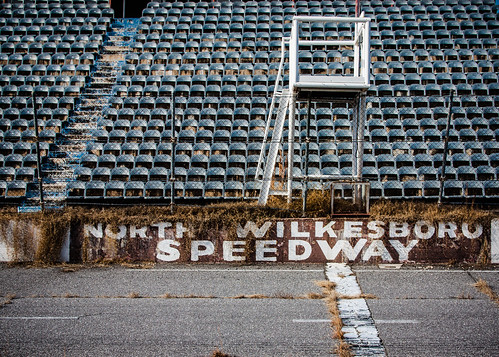
Photo: The starting line of the North Wilkesboro Speedway.
Nestled in the undulating hills of rural North Wilkesboro lies a dormant behemoth. Its vehicular roar shattered the natural ambiance to the cheers of thousands of spectators. For five decades the North Wilkesboro Speedway offered racing fans a chance to see racing greats up close.
During Prohibition moonshiners in the Appalachians modified their vehicles to outrun the authorities. Even after the disastrous social experiment with Prohibition ended, some Americans developed a taste for illicit liquor. Thus a thriving demand for tax-free moonshine continued to spur automobile innovation. Moonshine “runners” continued to push automobiles well past their factory specs well into the 1940′s.
The hilly forest countryside of Wilkes County and its geographic proximity to the large urban centers of Charlotte, Greensboro, and Winston-Salem made it an ideal location for runners. The raw power of these heavily modified vehicles attracted the attention of the public whenever they gathered to race. These unregulated races were rife with safety hazards for drivers and spectators alike. The rules were often treated merely as suggestions by participants. Unscrupulous race organizers sometimes made off with the proceeds before the conclusion of the race.

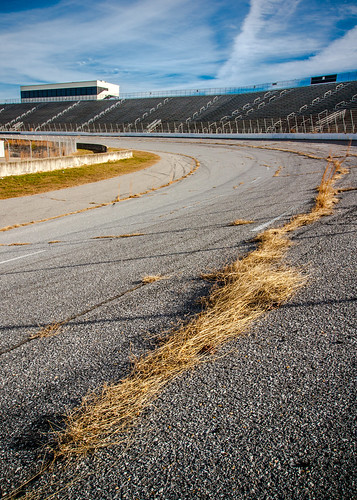
Photo: Grass growing through the cracks in the track.
William France, Sr., having been burned one too many times by shady race organizers, decided to legitimize these races by the creation of a self-governing body. In the mid-1940s France met with race organizers all over the American south to build his vision. Wilkes County residents Enoch Stanley, Lawson Curry, and Jack and Charlie Combs purchased farmland in 1945 to develop a track. Funding for the project ran short, which resulted in an unintentionally abnormal track design. The .625-mile length of dirt track was not a perfect oval, ran downhill on the front stretch, and uphill on the back. Despite its peculiarities the public came out in droves. Races began in 1946, with official NASCAR races shortly thereafter. Driver Robert “Red” Byron won the final race of the 1949 season at North Wilkesboro Speedway to become the very first NASCAR champion.
Over the next few decades NASCAR shifted gears. Engineering feats produced faster vehicles that required larger tracks. With larger venues came increased media exposure, marketing opportunities, and expanded audiences. To keep pace North Wilkesboro Speedway CEO Enoch Staley introduced a number of amenities to keep the track relevant. Expanded grandstands, air-conditioned viewing boxes, an electric scoreboard, and other attractions kept race fans coming to the short track. By the 1990s, however, the track’s position in the NASCAR lineup began to fall too far behind the competition. On September 29, 1996 driver Jeff Gordon won the final Winston Cup race to bring an end to NASCAR at the track.

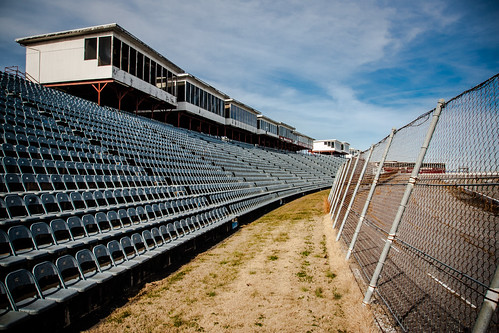
Photo: Notice the proximity of the grandstand next to the track.
In the period following the final NASCAR race there have been other minor events that have paled in comparison. After protracted disagreements about how to reinvigorate the track and several public gestures that ultimately amounted to nothing, Speedway Motorsports, Inc. has yet to determine the fate of the track. Despite the apparent neglect ardent grassroots support is evident as devoted racing fans try to resurrect the decaying venue. In 2008 fans petitioned North Carolina to place a historical marker signifying its cultural significance. Ongoing efforts by Save the Speedway are resolved to bring awareness to die-hard racing fans connected by social media.
Urban exploration, or in this case rural, focuses largely on abandoned buildings. This track is not abandoned. It is in that painful state just before total abandonment or demolition. Reminders of a glorious past still adorn the speedway. A fading Winston Cup mural at the main gate. The rusting electric leaderboard bearing a Tyson sponsorship. The giant sun-scorched orange Union 76 ball. The luxurious viewing boxes are painted with mold. Wild grass has broken through concrete track. A racing fan who has fond memories of the track in its prime would be sorely disappointed.
Video: ESPN footage of the final NASCAR race at North Wilkesboro Speedway.
Resources:
NC Markers – M-56 historical marker for the North Wilkesboro Speedway.
Racing Reference – NASCAR race results for the track.
Save the Speedway – An effort to revitalize the North Wilkesboro Speedway.
Save the Speedway – Andrew J. Baker – When The Engines No Longer Roar: A Case Study of
North Wilkesboro, NC and The North Wilkesboro Speedway.
YouTube – ESPN coverage of Jeff Gordon winning the final NASCAR race at North Wilkesboro Speedway.
Wikipedia – Entry for the North Wilkesboro Speedway.
Wilkes Journal-Patriot – 2012 article on the effort to revive the sparsely used track.
A new urbexer from Wisconsin shares his insights into an exploration of the Stonewall Jackson School.
Kyle Tretow on Flickr.
Subscribe to the American Urbex Podcast on iTunes and YouTube.
American Urbex on Flickr
American Urbex on Facebook
American Urbex on Twitter
Central State Hospital in Indianapolis served the Indiana community for 146 years.
Subscribe to the American Urbex Podcast on iTunes and YouTube.
American Urbex on Flickr
American Urbex on Facebook
American Urbex on Twitter
The American Urbex Podcast will take a brief hiatus during the month of July. Don’t worry, it’ll be back come August. There are three legitimate reasons why this break is necessary.
1. Marriage
You may not know my significant other, but they are perhaps American Urbex’s most ardent supporter. We’re getting married this week.
2. Master’s
I am putting the finishing touches on my master’s thesis. This is a very labor intensive process that will demand my attention until the end of the month.
3. Moving
I will be moving to the eastern portion of the United States at the end of July. I am looking forward to getting a chance explore new locations. The real thrill is going to be meeting new urbex photographers.
You may recall that American Urbex was able to raise funds earlier this year. Those funds are going to be put to use in August. If you are an urban explorer in the American southeast and wish to explore, by all means email americanurbex@gmail.com. Let’s meet up.
Thank you for your ongoing support,
Ken Fager
American Urbex
Kely McClung talks about his upcoming film Altered, the challenges of indie filmmaking, and the creative forces that drive him.
Altered – Official Website
Altered – IMDB Page
Altered – Facebook Page
Subscribe to the American Urbex Podcast on iTunes and YouTube.
American Urbex on Flickr
American Urbex on Facebook
American Urbex on Twitter
Photo: A stadium doomed from the very beginning.
Sports play a quintessential role in experiencing the American Dream. On the field, court, track, pool or rink is where our heroes are born. It is a place where even those coming from less than ideal circumstances can rise above their social station. These venues are secular churches to the American Dream: a place where people can congregate, worship the spectacle of conflict, and adore those with seemingly superhuman abilities. On the western edge of Gleason Park in Gary, Indiana is such a church. Concrete walls are collapsing around the narthex. Weeds grow unfettered in the sanctum of the football field. The roar of the crowd in the pews are not but the chirping of fleeting birds. With no gods to worship, the American Dream is essentially dead at Gilroy Stadium.
In January, 1955 mayor Peter Mandich pushed the city council for the construction of a sports complex called the South Gleason Park Athletic Complex. Mandich promised the council that if costs exceeded their ability to pay that the project would go no further. The council decided to go forward with the construction of a stadium as the first element, funding construction to the tune of $350,000 in bonds. Several weeks later Mandich again appealed for funds to complete the stadium, stating ”I’d much rather not build a stadium if we’re not going to build a decent one.” Throughout the bidding process city officials were given low-ball estimates to work with. Before long it was discovered that over $687,000 was already awarded to independent contractors. Cost overruns continued to loom as construction wrapped up in 1956 and the final bill amounted to $1 million dollars (or more than $8.5 million adjusted for inflation).
Comparing the stadium to another sports facility of the era illustrates just how horrendous spending on the project had become. Built in 1957 at a cost of $940,000, Lambeau Field in Green Bay, WI used 11,000 tons of steel to complete an NFL calibre venue that could seat 32,000 fans. The stadium in Gary, built in a city that the steel industry defined, used a paltry 630 tons and could only seat 10,000. Citizens were understandably livid at having to foot the cost of a substandard facility. Plans to construct additional sports facilities for the South Gleason Park Athletic Complex came to a screeching halt.
Despite the enormous amount of money poured into the football field several features were never finished. Bleachers, concession stands, and restroom facilities to accommodate 5,000 fans on the south side of the football field never materialized. Staff offices, maintenance facilities, and an additional locker room also never saw the light of day. Gravel for an eight lane running track surrounding the football field was laid down, but never actually paved.

Photo: The press box has been cordoned off, but the field at large remains wide open.
The stadium took its namesake from local citizen John F. “Jack” Gilroy. He had come to the area in 1911 and took a gym teacher position at Emerson High School. The affable Gilroy rose to become the city’s first athletic director four years later. By the time the stadium was complete, and Gilroy ready to retire, the venue was named in his honor. At the grand opening on September 1, 1956 all eight area high schools participated in Football-O-Rama exhibition games.
By 1962 the façade that Mandich had enthusiastically pitched just a few years prior was beginning to literally fall apart. Building inspectors noted considerable cracking and moisture damage in the concrete supporting the bleachers. Scandal swirled around the field when federal investigation into six individuals involved with project were convicted for kickbacks and bribes during development. Nothing more than a coat of fresh paint was used to put the concerns about construction to rest.
Photo (source): The Jackson 5 with Mayor Hatcher at Gilroy Stadium.
Between 1963 and 1973 local schools found Gilroy facilities unable to meet their needs. Most decided that it was in their best interest to construct their own facilities instead of paying rental fees, which hastened the decline of Gilroy Stadium. As the number of sporting events precipitously dwindled, city officials populated the schedule with alternative events. During the annual talent search in 1965 an upstart family act called The Jackson 5 won with their performance of “Bearfootin’.” Their stunning performance garnered the group’s first notable media mention in the local Gary Post Tribune. The Jackson 5 would return to Gilroy Stadium again in 1968, but this time they were signed under the famed music label Motown Records.
Over the next thirty years the languishing facility would only be used intermittently. Anecdotal evidence says that the scoreboard has not been lit since some point in the 1980s. Tower lights that went dark were no longer replaced. In 1994 concrete collapsed onto an electrical transformer, which knocked out power and lead to the cancellation of the Taste of Gary festival. Functional indoor plumbing only existed in the distant memories of those who knew the stadium in its prime. In between use weeds would consistently reclaim the surrounding area.
Photo: Weeds growing over the concourse up to the bleachers.
The beleaguered venue was again embroiled in controversy after the city granted the Ku Klux Klan the right to hold an event at the stadium in 2001. On the day of the gathering a crowd of protesters greatly outnumbered the 25 Klan members in attendance. It was reported that the protesters were able to drown out the hate speech by singing “We Shall Overcome” in unison.
A vast majority of the events at the stadium have been significantly more benign in comparison. The field has been sporadically used for a variety of concerts, friendly competitions, and other public gatherings. Because the bleachers were wholly unfit public use a significantly smaller set was constructed to accomodate audiences. Although the stadium was worse for wear, the Gary Golden Bears semi-pro football team called it home for 15 years.
In 2002 park department officials finally locked the gates and erected no trespassing signs around the perimeter fence. Curious explorers will find relatively little left behind at the barren stadium. Upper level concrete floors have begun to cave into the lower. Unlocked doors sway whenever the wind catches them right. The bleachers are faded white from a constant barrage of harsh sunlight. Vines have taken root and are working their way up with a level of patience only found in nature. Steel exposed to the elements has succumbed to relentless oxidation. On the north side a relatively new baseball diamond has been constructed, but even that has shows signs of neglect endemic to Gary.
As with many other building proposals planned for Gary the future of Gilroy Stadium seems to hang perpetually in the balance. One proposal to construct a casino on the property has all but stalled. Another proposal includes donating the property to be the future site of a museum dedicated to the memory of Michael Jackson. In the absence of sporting gods to worship, it seems almost fitting that the land be dedicated to other American deities: money and celebrity.
Resources:
Google Books – The Jackson 5 perform a benefit concert at the stadium in 1968.
Google Books – Two photos of people at Gilroy Stadium in its heyday.
Google Books – Briefly mentions Gilroy Stadium in relation to the Jackson’s home.
J5 Collector – Photo of The Jackson 5 during Gary’s Festival at the stadium in 1969.
Post Tribune – 1996 article on the troubled history of Gilroy Stadium.
Post Tribune – 2001 article comparing Gary, Indiana’s Gilroy Stadium to Lambeau Field in Green Bay, WI.
Post Tribune – 2001 article detailing the Ku Klux Klan rally event and protest.
Post Tribune – 2001 article citing the number of Ku Klux Klan members at the event.
Post Tribune – 2002 article on the uncertain future of the stadium.
Post Tribune – 2010 article on the details of a Michael Jackson museum.
Post Tribune – 2011 article on the stalled Michael Jackson museum.
Region Sports – An article on the rise and fall of Gilroy Stadium.
Region Sports – Miscellaneous facts about Gilroy Stadium.
The Jacksons – The Jackson 5 win an annual talent search at the stadium in 1965.
Sally Blottiaux gives American Urbex an interview outside of the City United Methodist Church in Gary, Indiana.
Subscribe to the American Urbex Podcast on iTunes and YouTube.
American Urbex on Flickr
American Urbex on Facebook
American Urbex on Twitter